bCoatch

How Career Transition Coaching Strengthens Your People, Brand, and Culture

How Career Transition Coaching Strengthens Your People, Brand, and Culture
Career Transition Coaching

Organizational change is never just operational. It affects people’s confidence. It shapes how teams view leadership. It influences how your company is talked about long after decisions are made.

This is why career transition coaching matters. It is not just a support service. It is a leadership decision that protects people, brand reputation, and company culture.

Below is a practical look at what it is, why it matters, and how to implement it well.

What Is Career Transition Coaching?

Career transition coaching is structured support for professionals navigating career change. It can be delivered one-on-one or in groups. The goal is simple. Help people move forward with clarity and confidence.

It typically includes:

  • Career clarity and goal setting
  • Strengths and skills assessment
  • CV and LinkedIn positioning
  • Interview preparation
  • Networking strategy
  • Confidence and resilience support

This is not just about job search tactics. It is about helping someone think clearly about their next chapter.

Career Transition Coaching vs. Traditional Outplacement

Traditional outplacement focuses on job search mechanics.

Resume writing. Interview workshops. Application strategies.

Career transition coaching goes deeper.

Outplacement asks, “How do I get hired?”

Coaching asks, “What direction actually makes sense for me?”

Many organizations combine both. That balance often delivers better long-term outcomes.

Why Career Transition Coaching Matters During Organizational Change

Career disruption is one of the most stressful professional experiences.

It affects identity. Confidence. Financial security. Family stability.

When companies provide structured coaching support, they reduce uncertainty. People regain clarity faster.

For HR leaders, that translates into:

  • Lower reputational risk
  • Fewer disputes and escalations
  • A more stable internal environment
  • More positive exit experiences

Handled poorly, transitions damage trust.

Handled well, they often strengthen it.

Leadership maturity is tested in moments like this.

If you have explored the 6 Core Executive Coaching Principles for Leaders, you already understand how consistency, clarity, and empathy shape credibility. Career transition coaching applies those same principles during a career change.

The Business Risks of Poorly Managed Transitions

Many organizations focus on restructuring mechanics.

They underestimate the human impact.

That impact has real business consequences.

Employer Brand Damage

Employees share their experiences publicly. Future candidates read those reviews carefully. Employer reputation influences:

  • Application volume
  • Offer acceptance rates
  • Cost per hire
  • Time to fill

A negative transition experience spreads quickly. A respectful one does too.

Survivor Syndrome

Employees who remain often feel anxious or uncertain. This is commonly referred to as survivor syndrome.

It can result in:

  • Lower engagement
  • Reduced productivity
  • Higher voluntary turnover

How you treat departing employees directly affects those who stay.

Leadership Credibility Risk

If transitions feel abrupt or impersonal, leadership trust declines. Rebuilding that trust is difficult. And slow.

How Career Transition Coaching Protects Employer Brand and Company Culture

Career transition coaching acts as a reputational safeguard.

Preserving Organizational Values

If your company says it values people, the moments of change test that claim. Coaching shows consistency between stated values and real action. People remember that.

Turning Existing Employees into Advocates

When individuals feel respected and supported, they are more likely to:

  • Leave balanced or positive reviews
  • Refer talent in the future
  • Maintain professional relationships
  • Speak well of leadership

That goodwill matters long after the transition ends.

Strengthening Internal Trust

The remaining employees are paying attention. Visible support signals fairness and empathy. That stabilizes morale and reinforces culture.

Career Transition Coaching vs. Outplacement Services: What’s the Difference?

The distinction matters when designing support programs. Outplacement services focus on practical job search steps.
Career transition coaching focuses on clarity, mindset, and long-term direction.

Outplacement typically includes:

  • Resume and interview preparation
  • Job search tools
  • Application guidance

Career transition coaching includes:

  • Career reflection and direction
  • Confidence rebuilding
  • Identity and mindset support
  • Sustainable career planning

For mid-level and senior leaders, this deeper support is often more valuable than standardized workshops.

Cost-Effective Career Transition Coaching Models for Organizations

Budget concerns are common during restructuring. Support does not have to be excessive to be meaningful. There are practical options.

1. Group Career Transition Coaching

Small group sessions reduce the cost per employee. They also create peer support and shared learning.

2. Short-Term Packages

Three to six-month programs focus on the most critical transition window. This keeps investment controlled while delivering impact.

3. Virtual Delivery

Remote coaching reduces logistical costs and expands access across locations.

4. Blended HR Support Models

Some organizations combine:

  • Internal HR guidance
  • External certified coaches
  • Digital career tools

The right model depends on company size and workforce needs.

Measuring ROI and ROE in Career Transition Coaching

Leaders often ask about return on investment. Placement rates are one measure. They are not the only measure.

Quantitative Metrics

  • Retention of high performers after change
  • Engagement survey scores
  • Voluntary turnover rates
  • Offer acceptance rates in future hiring cycles

Qualitative Metrics

  • Employer review sentiment
  • Perception of leadership credibility
  • Internal trust indicators

Return on Empathy

There is also what many call Return on Empathy. When organizations act with care, trust remains intact.
Companies that maintain trust during difficult periods often recover faster
and retain stronger leadership capital.

Best Practices for Implementing Career Transition Coaching

Career Transition Coaching

If you invest in career transition coaching, implement it thoughtfully.

Partner with Certified Coaches

Look for:

  • Recognized professional accreditation
  • Experience with organizational change
  • Strong confidentiality standards

Trust is essential for coaching to work.

Communicate Clearly

Employees should know:

  • What the coaching includes
  • How long does it lasts
  • How to access it
  • That it is confidential

Clarity reduces skepticism and increases participation.

Align with Company Values

If your organization emphasizes growth and development, your transition support should reflect those principles. Consistency builds credibility.

Support Managers Too

Managers guiding employees through change carry emotional pressure. Equip them with guidance and preparation.
It reduces mistakes and protects relationships.

Final Thoughts

Organizational change is inevitable. How you handle it defines your leadership. Career transition coaching protects people, the employer brand, the company culture, and future hiring power. It shows that even in difficult moments, values matter. When designed well, it reduces reputational risk, strengthens internal trust, and positions your organization for stronger long term performance.

Get Expertise in Career & Role Transition Coaching in Dubai

For organizations operating in the UAE and the Middle East, local context matters. bCoached offers Career and Role Transition coaching in Dubai, tailored to professionals navigating redundancy, promotion, or career shifts. Their approach goes beyond CV updates. It combines clarity work, resilience support, and practical planning.

Coaching typically focuses on:

  • Clarifying motivations, values, and career goals
  • Creating realistic next-step plans
  • Addressing both the emotional and practical sides of change
  • Supporting identity shifts during role transitions

In a market with high professional mobility and multinational teams, structured transition coaching adds realvalue. It helps individuals move forward with confidence. And it signals to current and future talent that your organization invests in people,
even during times of change.

FAQs

What is career transition coaching?

It is structured professional support that helps employees navigate career change, rebuild confidence, and move toward meaningful next roles.

Is it the same as outplacement support?

No. Outplacement focuses mainly on job search tools. Career transition coaching includes emotional resilience, career clarity, and long-term positioning.

Does career transition coaching improve employer brand reputation?

Yes. Employees who feel supported are more likely to share balanced or positive feedback publicly.

How long should career transition coaching last?

Most effective programs run between three and six months. Duration depends on role level and market conditions.


6 Core Executive Coaching Principles for Leaders

Executive Coaching Principles, Frameworks, and Conversations That Build Strong Leaders
Executive Coaching Principles for Leaders

In today’s complex workplace, leadership is no longer just about direction and decision-making; it’s about developing people. Executive Coaching Principles for Leaders provide the foundation for equipping leaders with the mindset, skills, and structure needed to guide meaningful growth conversations without micromanaging or simply giving advice.

At bCoached, we work with leaders, professionals, and organizations to turn everyday workplace conversations into powerful moments of learning, alignment, and performance.

Why Executive Coaching Principles for Leaders Matter in Modern Organizations

Leaders are increasingly expected to coach their teams, peers, and even senior stakeholders. Yet many hesitate:

  • What should I ask?

  • How do I challenge without damaging trust?

  • How do I support growth without taking over?

This is where a proven executive coaching framework and clear coaching principles make all the difference.

Executive coaching helps leaders:

  • Build trust and psychological safety

  • Improve communication and decision-making

  • Strengthen accountability and ownership

  • Develop high-performing, future-ready teams

The Assessment – Challenge – Support Coaching Framework

At the heart of effective Executive Coaching is a simple, research-based model: Assessment – Challenge – Support (ACS). This framework provides leaders with a practical structure to guide coaching conversations with confidence.

Step 1: Assess — Understanding the Current Reality

Every coaching conversation begins with curiosity. Assessment is about helping the coachee reflect on where they are right now—without judgment or rushed solutions. This stage builds trust and self-awareness.

Powerful assessment questions include:

  • What’s working well in this situation?

  • Where do you feel stuck?

  • How do you see your role in this challenge?

By slowing the conversation down, leaders help others feel heard and gain clarity before moving forward.

Step 2: Challenge — Expanding Thinking and Possibility

Once awareness is established, effective coaching gently stretches thinking. Challenge is not criticism. It’s about encouraging reflection, reframing assumptions, and exploring new options.

Effective challenge questions include:

  • What assumptions might you be making?

  • What alternatives haven’t you considered?

  • If fear wasn’t a factor, what would you try?

This phase often unlocks breakthrough insights and fresh perspectives.

Step 3: Support — Turning Insight into Action

Coaching only creates impact when insight leads to action.

Support focuses on follow-through, accountability, and encouragement—while keeping ownership with the coachee.

Support questions might include:

  • What’s one action you’ll commit to this week?

  • What support do you need moving forward?

  • Who else can help you succeed?

This step ensures coaching conversations lead to real, sustained change.

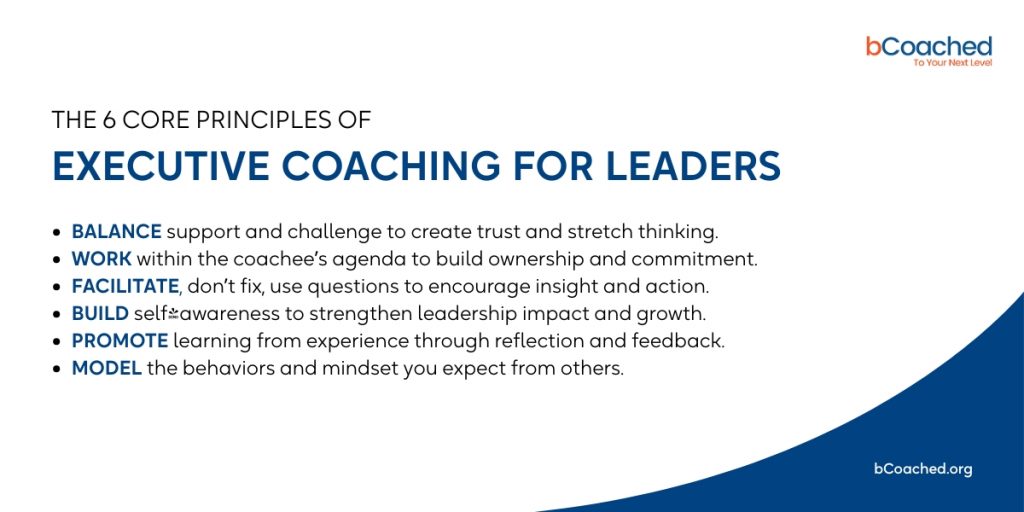
6 Core Principles of Executive Coaching for Leaders
Executive Coaching Principles for Leaders

Beyond frameworks, effective Executive Coaching is grounded in a set of essential principles. Whether you’re a leader coaching internally or working with an external coach, these principles remain consistent and practical across contexts.

1. Balance Support and Challenge

High-impact coaching creates a space that feels both psychologically safe and appropriately stretching. Leaders often lean too far in one direction—either being overly supportive to avoid discomfort or overly challenging in ways that erode trust.

Effective executive coaches strike a balance. They acknowledge effort, validate emotions, and show respect, while also asking questions that invite reflection and stretch thinking. When people feel supported and challenged, they’re more willing to take risks, explore new behaviours, and grow.

2. Work Within the Coachee’s Agenda

Executive coaching is most powerful when it honors the coachee’s priorities. Rather than imposing solutions or pushing personal viewpoints, strong coaches allow the coachee to define what success looks like.

This principle preserves trust and ownership. Even when organizational goals are involved, keeping the conversation collaborative ensures the coaching relationship remains intact. Leaders who coach within the coachee’s agenda empower others to take responsibility for their growth rather than comply out of obligation.

3. Facilitate, Don’t Fix

One of the most common pitfalls leaders fall into is solving problems too quickly. While giving advice can feel helpful, it often limits learning and reduces accountability.

Executive coaching shifts the focus from fixing to facilitating. Through active listening and thoughtful questions, leaders help others uncover their own insights. When people arrive at their own conclusions, they’re more committed to action and more capable of applying learning in future situations.

4. Build Self-Awareness

Self-awareness is the foundation of effective leadership—and a central outcome of executive coaching. Leaders who understand their strengths, blind spots, values, and impact on others are better equipped to adapt and lead intentionally.

Coaching conversations encourage reflection, feedback, and honest assessment. Equally important, coaches must model self-awareness themselves. Leaders who acknowledge their own learning edges create a culture where growth feels normal and safe.

5. Promote Learning From Experience

Lasting development doesn’t come from theory alone—it comes from experience and reflection. Executive coaching helps leaders extract meaning from real situations, successes, and setbacks.

By revisiting experiences and exploring what worked, what didn’t, and why, coaching turns everyday challenges into learning opportunities. This principle ensures growth continues long after a single coaching conversation ends.

6. Model the Behavior You Coach

Perhaps the most challenging principle is also the most powerful: be the leader you’re encouraging others to become.

Leaders who demonstrate curiosity, accountability, openness to feedback, and a commitment to learning reinforce coaching messages through action. Modeling desired behaviors builds credibility and trust, making coaching more authentic and impactful.

When leaders live the principles they coach, development becomes embedded in the culture—not just the conversation.

Executive Coaching in Dubai: A Strategic Advantage

Organizations increasingly seek executive coaching in Dubai to support leaders navigating growth, transition, and complexity. Many leaders also complement executive coaching with services such as:

  • Leadership Coaching for long-term capability building

  • Career & Role Transition Coaching during professional change

  • Team Coaching to strengthen collaboration and performance

Explore our related services:

Professionals searching for a career coach in Dubai or leadership development support benefit most when coaching is grounded in evidence-based frameworks and real workplace application.

Leadership Development Beyond Training

Unlike traditional leadership training in Dubai, executive coaching is personalized, reflective, and deeply practical. It meets leaders where they are—and helps them grow through real challenges, not simulations.

The result? Leaders who communicate better, think more strategically, and coach others with confidence.

Frequently Asked Questions

What are the benefits of an executive coaching program?

Executive coaching improves leadership effectiveness, self-awareness, decision-making, communication, and overall performance.

Why should an organization invest in executive coaching?

Organizations benefit from stronger leaders, higher engagement, improved retention, and better alignment with strategic goals.

What do participants gain from executive coaching programs?

Participants gain clarity, confidence, practical tools, and the ability to navigate complex leadership situations effectively.

How do I choose the right executive coach in Dubai?

Look for a coach with proven frameworks, relevant experience, strong credentials, and an approach aligned with your goals and values.

Is executive coaching suitable for senior leaders and high potentials?

Yes. Executive coaching supports both experienced leaders and emerging talent preparing for larger responsibilities.

Ready to Strengthen Your Leadership Impact?

Executive coaching transforms everyday conversations into opportunities for growth, trust, and performance. At bCoached, we partner with leaders and organizations to build coaching capability that lasts.