

Build High-Performing Teams With Our Four-Pillar Framework
Build High-Performing Teams With Our Four-Pillar Framework

Key Takeaways
- High-performing teams are built through intention, not just talent or headcount.
- Research shows that too many star performers can actually harm team results. Balance matters.
- Four pillars drive team effectiveness: clear purpose, shared mindset, cohesive relationships, and organisational connection.
- Leaders play a coaching role, not just a directing one, in sustaining team performance.
- Team coaching is one of the most effective investments for building long-term team cohesion and results.
What Is a High-Performing Team?
A high-performing team is a group of people who consistently achieve results that exceed expectations not by accident, but through a combination of shared purpose, clear roles, open communication, and genuine trust in one another.
What most leaders get wrong is equating high performance with high talent. Talent matters, but it’s rarely the deciding factor. The way a team functions as a living system, how its members communicate, make decisions, handle pressure, and support each other,r determines far more about outcomes than the individual credentials of its members.
More Than the Sum of Its Parts
High-performing teams have a collective intelligence that exceeds what any one member could produce alone. They make better decisions because diverse perspectives are heard. They execute faster because roles and processes are clear. And they sustain performance over time because the relationships underneath the work are strong.
In Dubai and across the Middle East, organisations increasingly recognise that competitive advantage lies not just in who they hire, but in how well those people work together, especially in hybrid, multicultural, and fast-moving environments.
Why Team Composition Isn’t Everything
It’s tempting to chase star power when building a team. But research consistently shows a counterintuitive truth: stacking too many exceptional individual performers can actually reduce team effectiveness. When more than roughly a third of a team is considered top performers, results often begin to decline, driven by competition for visibility, role overlap, and a breakdown in collective ownership.
This is sometimes called the “too-much-talent” effect, and it underscores a fundamental principle: building a high-performing team requires thinking beyond individual capability and focusing on how talent integrates, complements, and collaborates.
Why High-Performing Teams Are a Strategic Priority
The Business Case
The evidence is straightforward. Teams that function well deliver more higher productivity, faster execution, stronger innovation, and better retention. When alignment is strong, time isn’t wasted on clarifying confusion or managing internal friction. Energy goes to the work.
Organisations that invest in team effectiveness also tend to build stronger leadership pipelines. When people learn to collaborate, communicate, and lead collectively, the entire organisation becomes more resilient and adaptable to change.
The Human Case
Beyond business outcomes, high-performing teams are better places to work. People feel a sense of belonging, purpose, and psychological safety. They know their contribution matters and that their teammates have their back. That experience of being part of something that works is one of the most powerful drivers of engagement and long-term commitment.
Leaders who invest in team performance are investing in their people. And that investment compounds.
Four Pillars of an Effective Team
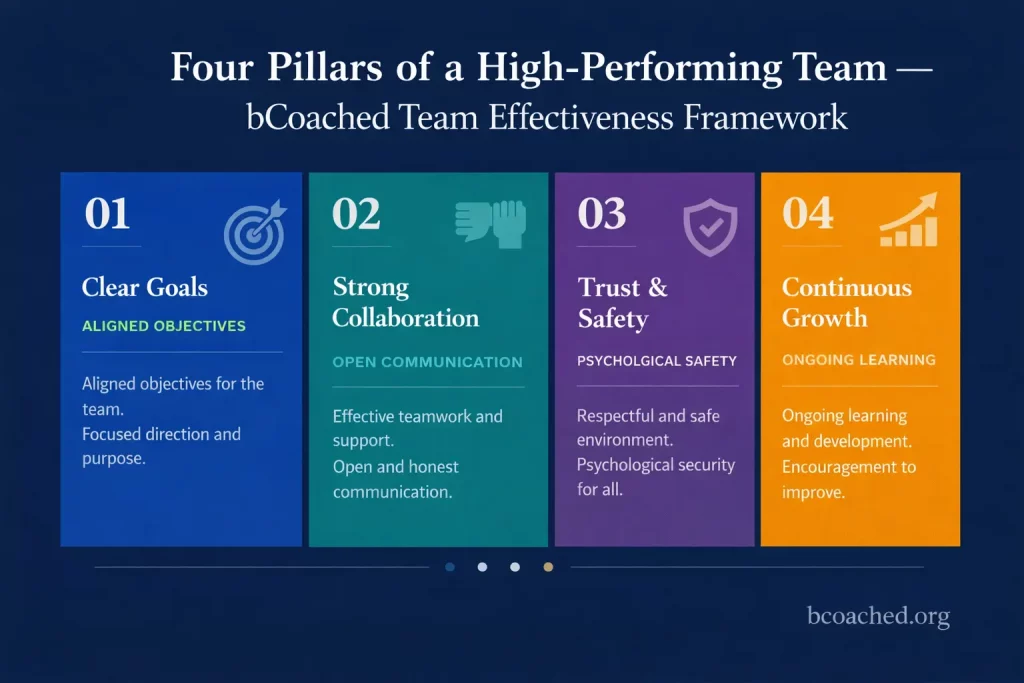
Drawing on systems thinking and team coaching research, we look at team effectiveness through four interconnected lenses. These pillars don’t operate in isolation; each one shapes and reinforces the others.
1. Core People, Purpose, and Practice
Every team needs a reason for being. Not just a job description, but a genuine shared understanding of why this team exists, what it’s trying to achieve, and how each member contributes to that mission.
Core is where talent enters the picture, but not as a ranking. The question isn’t “who are our stars?” It’s “how does each person’s contribution align with what we’re trying to build together?” Star performers matter most when they’re positioned to elevate the whole team, not just their own output.
2. Collective Mindset Shared Ways of Working
A collective mindset means the team has internalised not just what they’re working toward, but how they work. Roles are clear. Processes are understood. When one person is absent, others know how to step in seamlessly, not because they’re micromanaged, but because the team has a shared operating model.
Teams with a strong collective mindset can execute the metaphorical “no-look pass”; they anticipate each other’s moves, reduce friction, and create flow. Getting here requires deliberate conversations about norms, responsibilities, and decision-making conversations that most teams skip.
3. Cohesive Relationship, Trust,t and Psychological Safety
This is where many teams underinvest. Tasks and tools matter, but without genuine trust and psychological safety, no amount of structural clarity will unlock peak performance.
Psychological safety, ety the belief that you can speak up, challenge ideas, or admit mistakes without being penalised, is consistently identified in research as the single biggest predictor of team performance. Teams that feel safe think more clearly, share information more freely, and recover from setbacks faster.
Cohesion also matters during transitions. When new team members join, how existing members welcome them sends a powerful signal about what kind of team this is.
4. Connection Collaboration Beyond the Team
High-performing teams don’t operate as islands. They’re embedded in broader organisations, and their effectiveness depends partly on how well they connect with other teams, departments, and stakeholders.
In today’s increasingly cross-functional and hybrid workplaces, boundary-spanning the ability to build relationships across different roles, functions, locations, and backgrounds is a genuine competitive skill. Teams that do this well access more information, create more alignment, and avoid the silo-driven breakdowns that slow so many organisations down.
How to Build a High-Performing Team: Step by Step
Step 1: Start with Purpose and Clarity
Before you can align a team, you need to be clear on what it’s for. Define the team’s purpose, not just the list of deliverables, but the deeper reason it exists within the organisation. Connect individual goals to collective goals. Make sure everyone understands not just their own role, but how it fits into the broader picture.
Step 2: Build Intentionally, Not Just for Talent
When assembling or developing a team, think about the full picture: technical skills, collaborative behaviours, communication styles, and cognitive diversity. A team that thinks in the same way will produce predictable and limited results. Diversity of perspective, experience, and approach consistently leads to stronger problem-solving and better outcomes.
Also consider where your strongest performers sit within the workflow. The most impactful placement for high performers is often at the centre of key processes where their output benefits the whole team, not just their individual results.
Step 3: Create Psychological Safety
This doesn’t happen by declaring “our team is safe.” It happens through consistent behaviour over time. Leaders who model vulnerability, welcome dissent, and respond to mistakes with curiosity rather than blame create the conditions where people genuinely feel safe to contribute fully.
For leaders, this connects directly to the principles of great executive coaching. The same skills that help leaders grow individually can transform how they show up for their teams. If you haven’t explored what great leadership looks like from the inside out, read our piece on the 6 core executive coaching principles for leaders.
Step 4: Establish Shared Norms and Accountability
Great teams have explicit agreements about how they work. How decisions get made. How conflict gets raised. How feedback flows. These norms don’t need to be formal documents,s but they do need to be conscious and agreed on. Teams that skip this step spend enormous energy navigating unspoken assumptions and misaligned expectations.
Step 5: Invest in Communication Rhythms
High-performing teams communicate regularly and intentionally. This includes structured touchpoints, team meetings, one-to-ones, retrospectives,s but also the informal culture of how information flows day to day. Are updates shared proactively? Are concerns raised before they become problems? Is feedback given frequently or saved for annual reviews?
Communication rhythms need to be designed, not assumed. This is especially critical in hybrid or international teams where informal communication doesn’t happen naturally.
Step 6: Support Continuous Development
The best teams never stop learning. Leaders who create space for reflection, celebrate growth alongside results, and invest in skill development send a clear message: we’re here to get better, not just to deliver. That mindset is what separates teams that plateau from those that keep raising their ceiling.
This extends to how you support people through transitions, both into new roles and out of old ones. When individuals grow through change confidently, the team around them benefits too. Our article on how career transition coaching strengthens your people, brand, and culture explores this in more depth.
The Leader’s Role in Sustaining Team Performance
Leading with Clarity and Vision
Teams follow leaders who know where they’re going. That doesn’t mean having all the answers, but it means communicating direction clearly, making decisions with confidence, and being consistent enough that the team can orient around you during uncertain times.
Coaching, Not Just Managing
The leaders who build the strongest teams tend to approach their role as coaches, asking powerful questions, enabling reflection, and trusting their people to find solutions rather than simply directing them toward answers. This shift from “managing tasks” to “developing people” is one of the most impactful things a leader can do for their team’s long-term performance.
Modelling the Culture You Want to Build
Teams take their cues from their leaders. How you handle pressure, receive feedback, acknowledge mistakes, and treat your own peers shapes what the team learns is acceptable and what’s expected. You can’t build a culture of trust or psychological safety while behaving in ways that undermine it. Leadership presence and team culture are inseparable.
When to Bring in a Team Coach
Signs Your Team Needs External Support
Even well-intentioned leaders can struggle to see the dynamics at play within their own teams. An external team coach offers something leaders cannot always provide: an objective, systemic view of how the team is actually functioning.
Consider bringing in a team coach when you notice:
- Communication is polite, but not honest; the issues go unaddressed
- Performance is inconsistent despite clear goals and capable individuals
- Trust between team members seems low or has broken down after a difficult period
- The team is going through a significant change, such as a new leader, restructure, or major project
- Collaboration feels effortful, not natural, and silos keep forming
- The team is performing well now, but you want to unlock the next level
What Team Coaching Looks Like at bCoached
At bCoached, we view teams as living systems, not collections of individuals, but interconnected webs of relationships, habits, and shared assumptions. Our team coaching process begins with deep observation and listening before any interventions are suggested.
Our approach typically includes: an introductory meeting with the team leader, observation of a real team meeting, confidential one-to-one conversations with each member, a focused team offsite, and ongoing follow-up sessions to embed lasting change.
We combine emotional intelligence with business insight because sustainable team performance requires both. To find out more about how we work, visit our team coaching services page.
Common Mistakes Leaders Make When Building Teams
Understanding what not to do is just as useful as knowing the right steps. These are the most common failure patterns:
- Hiring only for individual talent without considering team dynamics or diversity of thinking
- Assuming alignment without checking its goals that feel obvious to leadership often aren’t clear to the team
- Focusing entirely on task delivery while neglecting team relationships and morale
- Delaying difficult conversations, small tensions that go unaddressed, compound into serious dysfunction
- Over-relying on a few star performers while under-developing the rest of the team
- Treating team-building as a one-time event rather than an ongoing practice
Conclusion
Building a high-performing team is one of the most valuable things a leader can do for the business, for the organisation’s culture, and for the people inside it. But it takes more than good intentions and talented individuals.
It takes clarity about purpose. It takes deliberate attention to relationships and trust. It takes communication rhythms that surface problems before they escalate. And it takes leadership that consistently models the behaviour it wants to see over time.
None of this is easy. But it is learnable, and it is coachable. The teams that perform at their best are rarely the ones with the most talent. They’re the ones who have invested in how they work together.
If you’re ready to take your team to the next level, get in touch with bCoached. We’d love to have a conversation about what’s possible.
Frequently Asked Questions
What is the difference between a team and a high-performing team?
Most groups of people working together form a team in name. A high-performing team is one where shared purpose, trust, clear roles, and open communication consistently produce results above expectations. The difference is rarely about talent,t it’s about how the team functions as a system.
How long does it take to build a high-performing team?
There’s no universal timeline, but meaningful progress is usually visible within three to six months of deliberate effort. Trust takes longer to build than processes or goals, and trust is the foundation of everything else restn. Team coaching programs typically run for three to six months to create lasting behavioural change.
Can remote or hybrid teams become high-performing?
Absolutely, but it requires more intentionality. Hybrid and remote teams need explicit communication structures, stronger feedback loops, and deliberate culture-building to compensate for the natural connection that comes from shared physical space. Many of bCoached’s clients work with distributed or hybrid teams across the UAE, Europe, and beyond.
How is team coaching different from team building activities?
Team building events can boost short-term morale, but they rarely create lasting change in how a team works. Team coaching is a structured, ongoing process that addresses the real dynamics at play, communication patterns, trust, accountability, and shared purpose. It creates durable behavioural and cultural shifts, not just a good day out.
What role does leadership play in team performance?
Leadership is one of the most powerful variables in team performance. The way a leader communicates, handles conflict, gives feedback, and models vulnerability sets the tone for everything else. Leaders who approach their role with a coaching mindset rather than purely a directing one consistently build stronger, more resilient teams. See our post on the 6 core executive coaching principles for a deeper look at how great leaders think and operate.