
How to Build a Skill Development Strategy That Matches Market Demand in 2026
TLDR
Most professionals waste time learning skills that don’t advance their careers. A market-aligned career development strategy starts with an honest skills audit, identifies what industries need through hiring data, bridges gaps with focused learning, and adapts continuously. The fastest-growing professionals in 2026 aren’t chasing trends; they’re building technical literacy, human-centric capabilities, and leadership skills that solve real business problems. This guide shows you how with a structured plan that works alongside a demanding career.
The Skills Development Mistake Costing You Career Growth
Here’s a scenario you’ve probably lived: You spend three months completing an online certification because it sounded valuable. You add it to your LinkedIn profile, wait for opportunities to arrive, and nothing changes. The course was interesting, the credentials look legitimate, but it didn’t move your career forward because you never asked the most important question first: Does the market actually need this?
In 2026, the disconnect between what professionals learn and what employers need has become expensive not just financially, but in lost time, missed opportunities, and careers that plateau while others accelerate.
The professionals advancing furthest aren’t necessarily the most educated. They’re the ones who treat their professional development like a strategic investment, built around market intelligence and executed with rigor.
This guide shows you exactly how to build that kind of plan, one that aligns your capabilities with what industries are actively hiring for and turns intentional learning into measurable career progress.
Why Market Alignment Matters More Than Ever
The professional landscape isn’t just changing, it’s accelerating in ways most organizations are still processing.
According to the World Economic Forum’s Future of Jobs Report, over 40 percent of core job skills are expected to change within the next few years. That’s not a distant forecast. It’s happening now across every sector and seniority level.
Artificial intelligence is reshaping workflows in finance, marketing, operations, and creative industries. Hybrid work has changed collaboration and trust-building. Automation is replacing task categories that were considered secure employment just five years ago.
In the UAE specifically, sectors like logistics, hospitality, healthcare, and professional services are seeing rapid transformation. Government initiatives around AI adoption and economic diversification are creating new demand patterns that didn’t exist in 2023.
The skills that got you hired three years ago might not keep you relevant three years from now. And the skills that will matter most in 2029 are already visible in hiring data today if you know where to look.
For senior leaders navigating organizational change, understanding how to align your leadership team around these evolving demands is equally critical. Learn how executive coaching services in Dubai can help you stay ahead of these shifts.
Step 1: Start With a Brutally Honest Skills Inventory
You can’t build a meaningful career development plan without knowing exactly where you’re starting from. Most professionals don’t actually know, not because they lack self-awareness, but because they’ve never mapped their capabilities systematically.
Hard Skills: Technical and Industry-Specific Knowledge
These are measurable capabilities: software proficiency, technical qualifications, industry credentials, data analysis skills, project management frameworks, regulatory knowledge, and language fluency.
List everything you can demonstrate competence in today, not what you learned once in a course five years ago.
Transferable Skills: Human Capabilities That Work Across Contexts
Leadership, communication, problem-solving, cross-cultural collaboration, adaptability, emotional intelligence, conflict resolution, and strategic thinking.
These often go undocumented because they feel intangible, but they’re exactly what employers struggle to find and pay premiums for. If you’ve led teams through uncertainty, communicated complex ideas to non-technical stakeholders, or built trust across cultural boundaries, those aren’t soft skills; they’re business-critical capabilities.
How to Conduct Your Audit
- List everything you do well, start broad, don’t filter yet
- Categorize by hard vs. transferable skills
- Rate each honestly: Beginner, Competent, Proficient, Expert
- Ask someone who has worked closely with you to review your list
- Document current credentials and formal training
Many professionals discover during this process that they’re stronger than they thought in some areas and weaker than they assumed in others. That clarity is exactly what makes the rest of the process work.
Step 2: Decode What Industries Actually Need
Understanding current demand is where most development plans fall apart. Professionals make decisions based on headlines or what sounds impressive, rather than what employers genuinely struggle to find.
Job Platforms as Real-Time Demand Data
LinkedIn, World Economic Forum, Indeed, Bayt, and GulfTalent publish thousands of postings daily. The skills listed most frequently aren’t coincidental, they’re what hiring managers can’t fill.
Search for roles one or two levels above where you are now. Note which skills appear repeatedly across the requirements sections. Those repetitions are the market telling you exactly what it values.
Industry Reports and Labor Market Intelligence
Government labor statistics, professional association publications, and industry reports from McKinsey, Deloitte, Korn Ferry, and PwC provide trend analysis that job postings can’t.
In the UAE, the Ministry of Human Resources and Emiratisation publishes workforce insights. The Dubai Future Foundation releases reports on emerging job categories. These tell you where demand is heading, not just where it is today.
Reading Between the Lines
When a job posting asks for “AI literacy,” they’re not looking for machine learning engineers. They’re looking for professionals who can collaborate effectively with technical teams and understand how AI changes workflows.
When “emotional intelligence” appears in leadership roles, it’s because organizations have learned the hard way that technical capability without people skills has a ceiling.
Three Skill Categories Dominating Hiring in 2026
- Technical Literacy (Not Expertise): You don’t need to become a data scientist, but you need to understand how data informs decisions. You don’t need to code AI models, but you need to know how AI is reshaping your industry and where human judgment still matters.
- Human-Centric Capabilities: Communication, emotional intelligence, cultural awareness, adaptability, and trust-building. These are increasingly difficult to automate and consistently cited as differentiators in hiring and promotion decisions.
- Leadership and Decision-Making Under Uncertainty: The ability to lead diverse teams, make decisions without perfect information, and navigate ambiguity is no longer reserved for senior roles.
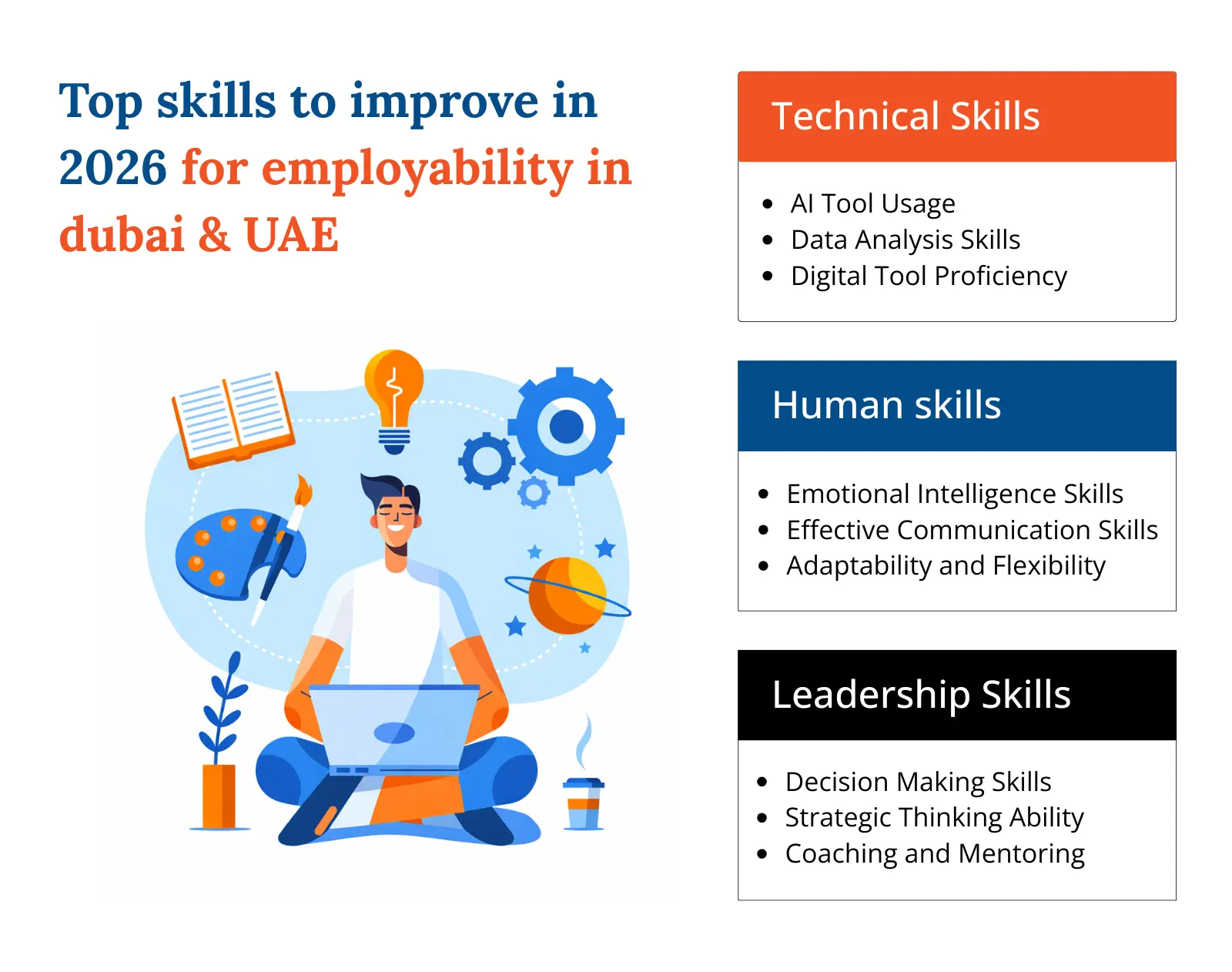
Developing these leadership capabilities takes more than self-directed learning. Professional executive coaching can accelerate progress on human-centric and leadership skills in ways that courses simply cannot.
Frequently Asked Questions
What is a skill development strategy in 2026?
A skill development strategy in 2026 is a structured, market-aligned plan that maps your current capabilities against what employers actively need, identifies the most critical gaps, and sets a clear roadmap for closing them. Unlike generic professional development, it is built on real hiring data, adjusted quarterly, and focused on depth over breadth.
How do I start building a career development plan as a professional?
Start with a skills audit list of every hard and transferable skill you can demonstrate today, rate your proficiency level honestly, and then research 10–15 job postings in your target area. The overlap between what you have and what those postings repeatedly require is your starting point.
How do I know which skills the market actually needs in my industry?
Use job platforms like LinkedIn, Indeed, and GulfTalent to identify patterns in what hiring managers list as requirements, not just preferred qualifications. Cross-reference with industry reports from McKinsey, Deloitte, or government labor bodies in the UAE, such as the Ministry of Human Resources and Emiratisation. The skills that appear consistently across multiple postings in your target level are what the market is paying for.
How is a skill development strategy different from just doing online courses?
Online courses are a tool, not a strategy. A skill development strategy determines which capabilities to build and why, based on market demand and your specific career goals. It then selects the most effective learning method for each capability, which may or may not be an online course, and includes accountability structures, application milestones, and quarterly reviews to ensure the learning actually translates into career progress.
What role does career transition coaching play in skill development?
Career transition coaching provides the external perspective and accountability structure that self-directed development often lacks. A coach helps you identify blind spots in your skills audit, pressure-test your market assumptions, and stay on track through the inevitable obstacles of a major career shift. bCoached’s career transition coaching services in Dubai are designed specifically for professionals navigating these kinds of changes.