















bCoatch

How Leaders can Unleash Employee Potential: The Power of giving Feedback

1684848399280

How Leaders can Unleash Employee Potential: The Power of giving Feedback

In the pursuit of organizational success, researchers have delved deep into the realm of employee performance, uncovering invaluable insights on how to increase productivity and drive growth. At the heart of this exploration, lies a prevailing belief: the key to unleashing the untapped potential within organizations lies in the adoption of a frequent, supportive and constructive feedback.

Feedback, in its essence, is a valuable stream of information derived from past actions, serving as a compass to navigate future actions. It is through feedback that we learn, grow and change. As leaders, it is our responsibility to create a culture that values and embraces feedback at all organizational levels.

Let’s imagine a manager who observes the performance of a junior team member during a client presentation. They can provide specific feedback, highlighting strengths such as confident body language and clear explanations. They can also address areas for improvement, such as the need of a more client-centric language.

Together with the team member the manager can set the goal of enhancing the performance, for instance, by incorporating story telling in the presentation. Moreover, the manager can identify relevant training resources for the team member to elevate their presentation skills.

With time, the employee can actively engage in practice sessions, incorporating the feedback received, while the manager continues to observe the team member’s presentation skills during client interactions. As the team member demonstrates progress when presenting to clients, the line manager provides recognition.

Feedback allows employees to track their progress and make timely adjustments where and when needed. Moreover, it fuels their desire to learn and achieve the results they strive for.

Having said this, in my experience as an executive coach I have observed that not every leader feels comfortable when it comes to providing direct feedback on the areas of strength and improvement in their team members’ performance. Instead of creating an environment where feedback is a common practice, they wait until the annual 360֯ evaluation to share such valuable information.

Unfortunately, this approach hinders the development and growth of individuals and teams within organizations. Moreover, it can result in employees being left unaware of their performance shortcomings until the end of the first year on the job, restricting their chances of advancement and professional growth.

In this article we are going to explore in more depth what giving feedback entails and how it can be delivered effectively, enabling employees to unlock their potential.

WHAT ARE THE MODELS OF FEEDBACK?

There are different models that can be used to provide effective feedback and that can offer a unique framework to enhance employee performance.   Here, we explore in more depth three commonly used model:

The Pendleton Model

The Pendleton model provides a framework for structuring meaningful and supportive conversations where the person receiving feedback is encouraged to identify goals and action plans through a process called “reflection for actions”.

This type of approach provides opportunities for reflection not only on the positive aspects of the performance but also on those areas that can be improved.

Let’s imagine a scenario where a manager in the marketing department, John, gives feedback to one of his team members, Sarah. Here’s an example of how their dialogue could be structured:

1. Opening and setting the tone

John: Hey Sarah, I wanted to give you some feedback on how you managed our recent marketing campaign.

Sarah: Sure! Let’s discuss it.

2.    Inviting reflections on areas of success and areas for improvement

John: what do you think you did well in designing the social media campaign? And what do you think you could improve?

3.    Team member’s self-assessment and own evaluation of performance

Sarah: I focused on creating content that was informative, entertaining and sharable, which I believe helped enhance the overall engagement and reach of our campaign. On the other hand, while I ensured I monitored the campaign’s performance, I think I can improve by diving deeper into the data and analysing key metrics.

4. Manager’s further comments and highlighted areas for improvement

John: I agree with you that the content you created was highly impactful.  When it comes to monitoring the performance of the campaign, I believe you did an excellent job too. What I see as an area of improvement, is drafting a call to action that encourages our audience to engage more with our content and creates sense of community around our brand. How do you think you could do it differently?

5.    Team member proposed action points

Sarah: to enhance the effectiveness of our call to action, I could focus on using strong verbs and compelling phrases, so that we create a sense of urgency and excitement. To achieve this, I can also incorporate incentives and rewards such as discounts, giveaways and access to premium contents.

As we can see, the Pendleton model transforms feedback into a genuine exchange of information and promotes transparency between the two parties involved.

Moreover, it empowers the receiving employee to take the lead in self-reflection, while enabling the feedback provider, whether a manager or a team member, to transition to the role of a supportive coach.

Start, Stop, Continue Model

The Start, Stop, Continue model is a popular feedback approach that involves identifying what an individual or a team needs to start doing, stop doing and continue doing.

This type of model allows both the feedback giver and receiver to focus on three distinctive categories by using a set of guiding questions.

Let’s consider a scenario in which a team leader directly asks their team members to give feedback on how to improve participation in team meetings. Here are the guiding questions that can be used during the conversation:

Start

What steps can I/we start taking to improve participation in team meetings?

What specific actions can I/we initiate to ensure I/we improve engagement and active involvement in team meetings?

Stop

Which behaviors or actions do I/we need to stop to improve participation in team meetings?

What specific changes can I/we make to eliminate any obstacle or barriers to active engagement?

Continue

What specific actions have been effective in improving participation in team meetings that I/we should continue doing?

How can I/we further strengthen and build upon these actions?

By utilizing these guiding questions, we are not only prompted to analyze our current patterns of thinking, actions and habits but also encouraged to make the necessary changes for continuous improvement.

This reflective feedback process empowers leaders and teams to identify areas of growth, eliminate ineffective behaviors, and reinforce successful actions, ultimately fostering a culture of active participation and continuous learning.

The Sandwich technique

The sandwich technique entails starting and ending with positive observations, with constructive information “sandwiched” in between.  The purpose of the sandwich feedback is to provide constructive comments in a supportive manner, balancing it with genuine praise. This approach helps maintain an encouraging and motivating environment while still addressing areas that require improvement.

While this method can be effective in everyday situations, it is important to note that if it is consistently used, its impact may diminish. The recipient of the feedback may start anticipating the “but” in the middle of the sentence. Therefore, it is crucial to provide standalone positive feedback whenever appropriate to acknowledge and support our co-workers consistently.

Let’s consider again the scenario between John, marketing manager, and Sarah, team member. Here is an example of how their conversation may be structured:

Manager starts with positive observations when giving feedback to his team member:

1. John: Sarah, I want to start by highlighting the exceptional job you did in crafting the social media campaign. Your creative ideas and use of language really stood out. The way you curated the content and used captivating visuals was impressive.

2.    Manager includes constructive information in the middle of the conversation:

John: now, if I may move on to the constructive feedback, I noticed a few areas where you can enhance the campaign effectiveness. Let’s focus on improving the call-to-action in the posts. While the content was engaging, incorporating a clear and competing call-to-action will help engage a larger audience.

3.    Manager finishes with positive observations:

John: having said this, I want to emphasize the great effort you put into this campaign. Going forward, let’s work together to enhance the call-to-action and continue elevate your skills in crafting impactful social media campaigns.

Remember, the sandwich technique is one of the ways of providing feedback. Ultimately, it is crucial that organization create an environment where daily acknowledgement and appreciation of team members’ efforts take place.

WHO IS RESPONSIBLE FOR GIVING FEEDBACK?

As an executive coach, I often challenge the common misconception that feedback solely flows from managers to their direct reports. Feedback is a two-way street. Through our professional journey, we not only receive feedback from our line managers, colleagues and clients, but we also have the responsibility to provide feedback to our managers and team members.  It is worth noting that in professional settings, the term “upward feedback” specifically refers to the feedback given to leaders or line managers by their team members.

When it comes to upward feedback, it is usually given anonymously to create a safe and non-threatening environment. Anonymity removes barriers such as power dynamics or apprehension about potential repercussion.

A feedback exchange that includes employees at all levels, fosters a culture of open communication and continuous growth within the organization, from senior leaders to junior employees.

HOW OFTEN SHOULD FEEDBACK BE GIVEN?

When leaders, managers and supervisors can create a working environment where their employees feel safe in giving and receiving valuable information about performance, feedback can become a weekly or even daily practice. There is no need to institutionalize the giving and receiving of daily feedback, as it is done when it comes to the annual performance review or 360֯ evaluation. It simply becomes an exercise employee engage in with the aim to learn and make adjustments.

As an executive coach, my role often revolves around exploring with clients the ways in which they can provide and receive timely and constructive feedback, while fostering a workplace culture that embraces feedback as an essential practice.

If you are a leader or line manager seeking to delve deeper into this topic, I invite you to book a complimentary chemistry call with me. Let’s embark on a journey together by using the link below:

https://calendly.com/silvia-executivecoach/30minutes

How to recognize a toxic workplace and transform it into a collaborative environment

1682004665452

How to recognize a toxic workplace and transform it into a collaborative environment

The expression “toxic workplace” is often used to describe a work environment characterized by frequent personal conflicts among its employees, often leading to a decrease in productivity and mental and physical well-being.

As an external observer in such an environment, you would notice behaviors like hostility, bullying, discrimination and employees feeling belittled, unsupported and even threatened.

In this article we are going to explore relevant characteristics of a toxic workplace and consider solutions for addressing it.

FOUR SIGNS OF A TOXIC WORKPLACE

According to a study (Gilbert, Carr-Ruffino, Ivancevich, & Konopaske, R. 2012) published by the International Journal of Leadership Studies, there are certain behaviors that are linked to a toxic workplace.  Here, we take a look at four of these behaviors:

1 Prioritizing personal agendas

Prioritizing personal agendas in the workplace means that employers and employees alike show the tendency of placing their own personal interests or goals over those of the company or team.

This may involve pursuing personal gains, such as power, money, fame or special status and using unethical means to achieve these goals.

A common example of prioritizing personal agendas is when a leader is more interested in achieving personal recognition than in supporting the growth and development of his/her team by working collaboratively.

This can include taking credit for the team’s work, failing to acknowledge the contribution of team members or using their work to further his/her own career goals without providing appropriate recognition or compensation.

In such a scenario, we can easily understand how team members can feel undervalued, demotivated and even resentful towards their boss or team leader. When they realize that their leader’s self-centered behavior is hindering their professional growth, they are likely to become disengaged and adopt an attitude that adversely affects their productivity.

Behaviors that prioritize personal agendas and contribute to a toxic work environment can also include pursuing short-term financial gains at the expense of long term growth and engaging in unethical practices like ignoring safety concerns or falsifying data, to mention a few.

At the core of these behaviors lies a self-centered approach where the individual, be it the leader, the supervisor or the team member, prioritizes personal gratification over creating a team that collaborates towards a shared goal, purpose and mission.

2 Aggressive or domineering leadership styles

Due to the high level of pressure that comes with their roles – demanding deadlines to meet, strict performance targets, being able to respond appropriately and timely to employees’ diverse needs and personalities – leaders may feel that they have to adopt an aggressive or domineering style to assert their authority.

This style can be characterized by outbursts or angry reactions when employees don’t meet the leader’s expectations and challenge his or her decisions.

A classic scenario is when a manager becomes visibly upset when a team member questions his or her decisions. The manager may criticize or belittle the employee in front of others and, as a result, the employee may feel embarrassed and demotivated.

A manager may also react similarly if an employee fails to meet a deadline or produces work that does not meet their high standards, even if the employee has a valid reason for the outcome.

It is important to note that organizations that support a domineering leadership style are often the product of a system that values short term results over long term sustainability. For example, if a company is under intense pressure to achieve financial targets, it may be tempted to adopt a top-down approach that prioritizes speed of implementation over collaboration and employee engagement.

3 Favoritism and absence of meritocracy

Giving preferential treatments based on factors that are unrelated to job performance, such as personal relationships and nepotism leads to favoritism in the workplace.

The ways favoritism manifest itself can vary. For instance, providing career advancement opportunities to certain employees over others based on factors other than job performance is one way.

Treating some team members with more respect and attention than others and overlooking performance or behavioral issues while disciplining or reprimanding others for similar issues is another.

In an ideal workplace, all employees should have equal opportunities to undertake challenging projects and assume greater responsibility. However, when favoritism comes into play, certain employees may repeatedly gain an unfair advantage and access these opportunities, leaving their colleagues with less appealing tasks.

Additionally, they may be assigned easier or more stimulating projects, while their peers are left to tackle less interesting tasks.

A common example of favoritism is when a leader takes side with the most outgoing employees, or those he/she is friendly with and unintentionally discourages more timid or quiet employees from voicing their opinions. This attitude can lead to a decrease in collaboration and can generate negative emotions among team members who are denied similar opportunities, resulting in missed chances for growth and development.

After all, when a company fails to recognize the value of individual contribution, engagement, collaboration and performance, it can lead to resentment, mistrust and conflict among employees.

4 Treating employees as a financial liability

It can be as simple as failing to recognize their contribution or withholding praise, but it can also be more insidious, such as cutting employees benefits or not compensating them for the additional hours worked.

A common example of how a company may treat its employees as a financial liability is communicating the need to reduce expenses in order to stay afloat, without providing a clear plan or vision for how it will overcome its financial difficulties and retain its staff.

This can lead to employees feeling undervalued and unappreciated in the long term, despite their additional responsibilities during times of financial strains.

If a company takes advantage of its employees when they are at their weakest by cutting their benefits or getting rid of them, it is likely that the remaining employees won’t be motivated to go beyond their call of duty to support the organization.

Another example is failing to provide support and resources during times of organizational change. For instance, if the company undergoes a merger or acquisition, or experiences a shift in strategy or an unexpected event, employees may be faced with increased workloads and pressure.

As organizational change can be a challenging time for employees, who may feel uncertain about their job security or the future of the company, effective communication is crucial during these periods. By providing regular updates on what is happening and on what the changes mean for employees, the company can help its people navigate the transition more easily.

Overall, it is vital that organizations take a proactive stance in looking after their people as human beings.   The support can include access to counselling or other mental health resources, as well as support in managing workloads or navigating changes in job responsibilities.

After all, these initiatives help to create stronger, more engaged, and more resilient teams.

HOW TO PREVENT THE CREATION OF A TOXIC WORKPLACE

Irrespective of whether an organization is aware of fostering a toxic workplace, the question remains: how can one prevent the creation of a toxic work environment in the first place?

The four behaviors mentioned above, are driven by a focus on personal advancement and power, rather than a focus on team work where every contribution is valued and supported.

Studies suggest that organizations should consciously strive to create a culture centered on a community-orientedapproach to work, which places human connection and collaboration at the forefront, leading to increased employee engagement, performance and well-being.

In practical terms, this means that in organizations where collaboration is valued, employees are surrounded by a network of supportive individuals, including leaders, managers and team members who work within a fair and equitable policy environment.

These organizations are known for creating a welcoming, nurturing, caring and supportive work environment, which stands in sharp contrast to toxic work environments.

When employees work together toward a common goal, and are supported by leaders who seek to promote their strengths by providing constructive feedback and nurturing equal and collaborative relationships, there is a noticeable increase in employee morale.

The key to creating a culture of human connection and collaboration is having leaders who model selfless, thoughtful, and generous behaviors when it comes to interpersonal relationships in the workplace. This is because leaders set the emotional tone for the organization.

Organizations are now encouraged to train their leaders and managers to operate as facilitators and coaches and, when needed, adopt a servant leadership style.

Leaders who act as coaches invest their time and energy in developing their team members, striking a balance between guiding and giving autonomy. However, it takes a conscious effort to train leaders and it requires investing in leadership development programs across the entire organization.

When you and your organization want to explore leadership coaching in more depth, I invite you to a confidential consultation with me. Use the link below:

https://calendly.com/silvia-executivecoach/30minutes

Alternatively, you can write directly to me: silvia@bcoached.org

References

Gilbert, J. A., Carr-Ruffino, N., Ivancevich, J. M., & Konopaske, R. (2012). Toxic versus cooperative behaviors at work: the role of organizational culture and leadership in creating community-centered organizations. International Journal of Leadership Studies, 7(1), 29-47

Decision fatigue: what it is and how it can impact performance

1675354243801

Decision fatigue: what it is and how it can impact performance

As human beings we can only make a limited number of high-quality decisions per day.  After a while, we inevitably come face to face with what is called “decision fatigue”.

Decision fatigue, also referred as ego depletionby social psychologist Roy F. Baumeister, (Baumeister et all., 1998), is a psychological phenomenon where our ability to make good decisions deteriorates after a long period of decision-making.

It occurs because making decisions requires mental effort and willpower, which are both limited resources.

Decision fatigue is a cumulative phenomenon: the more decisions we make, the harder it becomes to make additional ones without feeling mental exhaustion.

In this article we are going to explore decision fatigue in further depth as well as taking a look at how we can manage it.

What is decision fatigue?

Contrary to what some of us may think, decision fatigue is a normal human experience that can happen to anyone. It is not a disorder or permanent mental state.

It occurs when people are faced with a large number of decisions, particularly when they are difficult or important.  Moreover, it is more likely to happen when people are under stress, tired or hungry.

For instance, imagine a manager who spends the morning in back-to-back meetings, where they have to make a lot of decisions about the direction of their team and the organization.  By the end of the day, they may find themselves feeling mentally exhausted and struggling to make a simple decision like what to have or cook for dinner.   They may find themselves ordering takeout for the entire family or eating something unhealthy because they don’t have the mental energy to decide on a better option.

How do we know we are experiencing decision fatigue?

The more choices we are called to make throughout the day, the harder it becomes to make quality decisions. Eventually, our brain looks for shortcuts in two ways:

Avoidance: we put off or stay away from decision-making tasks by choosing the easiest of the options we have available: doing nothing.  This is an energy saver: instead of agonizing over decisions, we simply don’t take any (Tierney, 2011).

Impulsivity: we make rash decision and pick the first thing that comes to mind. Impulse buying is an example of decision fatigue.

While decision fatigue can often look like indecisiveness, there is a difference between the two.

The latter can be described a personality trait that is evident from the beginning whereas decision fatigue sets in only after making several decisions in a fixed amount time.  Moreover, decision fatigue can affect anyone, even those who tend to be extremely decisive.

What is the impact of decision fatigue on our performance?

Although researchers are still debating the effect decision fatigue, they have been observing the phenomenon.

Here are some of the observed behaviors associated to decision fatigue:

Poor decision-making: when we experience decision fatigue we find it difficult to make good decisions, leading to mistakes or poor judgment.

Lack of motivation: decision fatigue can lead to a lack of motivation which has a practical impact on how often we take action or make progress on important tasks.

Procrastination: we may find ourselves procrastinating on important decisions – this can result in missed opportunities or delays in achieving our goals and the ones of our organization.

Irritability: we may become irritable or easily frustrated and run the risk to undermine the quality of your relationships with team members and employees.

Burnout: decision fatigue can lead to burnout, which is characterized by physical and emotional exhaustion and a reduced sense of personal accomplishment.

Inability to delegate: when we feel mentally tired we lack the energy and the willpower to delegate tasks. This can lead to a bottleneck in decision-making and prevent our organization from running efficiently.

Risk aversion: decision fatigue can lead to a risk-averse attitude, which can make us more likely to stick with the status quo rather than taking bold action.

How to prevent decision fatigue

While we may not be able to avoid decision fatigue entirely, you can take steps to reduce it or keep it under control.

Here is how:

Create routines and automate our choices

Establishing routines and habits can help us reduce the number of decisions we are called to make every day. For example, we can automate certain decisions to free up mental energy for more important decisions.

From setting up automatic bill payments at the end of each month to using a master list for our food and grocery shopping – these are all scenario in which we can easily automate our decisions.

Prioritize decisions: assigning different levels of importance to our daily tasks. In business, this can be done effectively by using time management tools such as the Eisenhower matrix, the Decision Matrix Analysis or Paired Comparison Analysisto name a few.

In addition, it helps focus on the most important decisions early in the day when our mental energies are at their highest.

Delegate tasks: delegating tasks to others can help reduce the number of decisions that need to be made.

Limit options: intentionally limiting the number of options we have available gives us a selected number of choices only. This way we don’t have to dwell between choosing.

Take regular breaks: taking regular breaks throughout the day can help refresh our mind.

Self-care: here we are referring to eating nutritious food, exercising regularly and getting enough sleep.

While following these steps can help us prevent decision fatigue, let’s remember that it is normal for human beings to experience decision fatigue from time to time.

When you want to explore in more depth how you approach decision making, I invite you to book your confidential chemistry with me call by using the link below:

https://calendly.com/silvia-executivecoach/30minutes

References:

Baumeister, R. F.; Bratslavsky, E.; Muraven, M.; Tice, D. M. (1998).

Tierney, J. (2011). Do you suffer from decision fatigue. The New York Times, 17.

When leaders fail: causes and how to prevent it

1673275819652

When leaders fail: causes and how to prevent it

Sometimes leaders fail.  Whether this is through them not having the correct skills from the beginning or a plateau occurring after a while, the impact on the organization is equally damaging. The effects of leadership derailment include a decline in job satisfaction, a lack of teamwork and an increase in individual stress.

And the phenomenon is far reaching. Research suggests that up to around 25% of executives are at risk of leadership derailment. With the ability to develop awareness and learn to nurture positive qualities, however, they can prevent this from happening.

In this article we’re going to explore leadership derailment and its causes in further depth as well as taking a look at how you can prevent it from happening.

WHAT IS LEADERSHIP DERAILMENT?

Derailed leadership is any form of leadership that is unsuccessful. Like a train coming off the tracks an individual has been prevented from reaching their potential when steering a team in the right direction.

In some cases, leadership derailment refers to a leader who has reached this potential, but whose efforts are now beginning to decline. For example, a leader might derail when they are burned out and unable to adapt to meet a change in the organization more widely.

WHAT CAUSES LEADERSHIP DERAILMENT?

Outside of contributing circumstances such as organizational transitions and unusually heavy workloads, psychologists and CEO’s point to three main factors as the causes of leadership derailment.

Lack of leadership qualities

People who have personality traits and skills conducive to great leadership will understandably be less likely to experience derailment. Organizations can contribute to the problem by not properly screening candidates before hiring or promoting them.

Schaubroeck, Walumbwa, Ganster, & Kepes (Schaubroeck, Walumbwa, Ganster, & Kepes 2007) highlight that selection strategies should seek out positive traits early on. These traits will include:

  • Self-awareness
  • Strategic thinking
  • Honesty
  • Decisiveness
  • Selflessness
  • Communication
  • Empathy
  • Ability to inspire
  • Consistency

If an individual does not naturally have positive leadership qualities, this is not necessarily an issue so long as proper coaching and training is in place. It is only an issue when someone is unable or unwilling to change, showing a stubborn lack of flexibility or ego. We’ll touch more on coaching and training later in the article.

Difficult personal attributes

Even those with great skills can struggle with derailment. As de Haan and Kasozi (de Haan & Kasozi, 2014) recognize, personal strengths can quickly settle into patterns that are detrimental for an organization as a whole.

The very same attributes that can lead individuals to the point of being promoted to leader can hold others in the team back. For instance, a drive to get tasks completed can be motivating for a team, but it can also create shame and fear for those who work more slowly.

Lack of collaboration

Participants in Chief Executive’s and GrowthPlay’s Best Companies for Leaders survey recently pointed to a lack of collaboration as the main reason for leadership derailment. And it makes sense. Building and guiding a team requires a level of collaboration unfamiliar to most non-leaders in most fields of work.

Nurturing teamwork, being able to delegate and learning to recognize individual ability whilst directing the whole are all skills that must be honed. And where leaders fail to do so, they will often struggle or fail.

Insufficient training or development, the second highest cause listed in the survey, is also closely linked with collaboration issues. Leaders that aren’t offered formal support will struggle to know how to get the most out of each of their team members.

HOW CAN LEADERS PREVENT LEADERSHIP DERAILMENT?

Leaders themselves can look to use the following techniques to avoid derailment:

Avoid locked thinking and seek feedback

Particularly during times of stress, leaders can revert to “locked” and ineffective ways of thinking. They may limit their teams by not being open to new ideas or ways of doing things. This can quickly lead to inefficiencies and individuals feeling demotivated.

By seeking feedback and remaining open to new ideas, both on team decisions and their leadership skills more generally, people can ensure the flexibility needed in a healthy team.

Develop strategies to combat negative personality traits

All of the following traits can lead to leadership derailment and people should seek to become aware of when they are acting them out and to avoid doing so:

  • Lack of communication or empathy
  • Inability to learn from experience
  • Trust issues
  • Poor composure under stress
  • Dishonesty/lack of clarity

A useful way for leaders to become aware of their derailing tendencies/derailers is by seeking upward feedback during their annual review or 360˚. Ensuring that the upward feedback always comes to a constructive discussion between the leader and the employees/team members who gave the feedback is fundamental for developing the leader’s self-awareness.

Ultimately, it is down to the organization to promote a culture of feedback by creating the necessary space in which employees feel confident in giving practical and constructive upward feedback without the fear of being punished.

Foster transparency

Possibly the most important thing an individual can do to combat leadership derailment is to communicate openly with their organization about what support they need. During times when they are under pressure, this will be particularly important.

HOW CAN ORGANIZATION PREVENT IT FROM HAPPENING?

To prevent leadership derailment from occurring, organizations need a focused and targeted approach. They should seek to implement the following steps:

Empower leaders to become more accountable

As well as holding leaders accountable when they make mistakes, organizations need to empower them to take a proactive approach to honing their skills. Encouraging and incentivizing is crucial.

Select and promote carefully

As discussed earlier, a great leader has a few essential personal qualities. Organizations should also look to select someone who meets the needs of the personalities and culture of the team itself.

One instrument widely used for selection and talent acquisition by global organizations and Fortune 500 companies is the HOGAN Leadership Forecast Series. The Leadership Forecast Series provides an in depth look at eleven derailing tendencies that can get in the way of a leader’s effective leadership.

This instrument can be used not only for selection but also for leadership development coaching, allowing leaders to acquire strategic self-awareness not only to leverage their strengths but also to recognize and manage those tendencies that cause them to go off track.

Coach leaders effectively

Whether highlighting possible leaders or working with existing ones, executive and leadership development coaching is critical to avoiding leadership derailment. Executive coaches help leaders and managers alike analyse what behaviors are required of them in order to fully support their teams, foster collaboration and create a culture of feedback within their organization.

Executive and leadership development coaching allows leaders to find the necessary space to reflect in full confidentiality and away from their work environment. Moreover, it helps them evaluate their behaviors and refine their decision making process.

For specialized leadership coaching, get in touch with bCoached or directly with Silvia. Our executive coaching focuses on helping executives and managers increase their self-awareness, leverage their strengths as well as manage their derailing tendencies.

To book a fully confidential chemistry call with Silvia use the link below:

https://calendly.com/silvia-executivecoach/30minutes

References:

De Haan, E., & Kasozi, A. (2014). The leadership shadow: how to recognize and avoid derailment, hubris and overdrive. Kogan Page Publishers.

Schaubroeck, J., Walumbwa, F. O., Ganster, D. C., & Kepes, S. (2007). Destructive leader traits and the neutralizing influence of an “enriched” job. The Leadership Quarterly, 18(3), 236-251.

Your Life Script: what you need to know and why

1670931186281

Your Life Script: what you need to know and why

Do you keep getting into the same situations many times over? You could be bound to your “life script”.

EVERYTHING YOU NEED TO KNOW ABOUT LIFE SCRIPTS

Very early in our lives, we learn to build a narrative that informs how we make decisions, how we think about ourselves, and what we think of other people and the world around us.  In psychology, precisely in the branch of Transactional Analysis, this narrative is referred to as “life script”.

A life script can be described as a template we use to organize what we think and do and shape our self-image.  Although life scripts helps us make sense of the world around us, especially at a young age, they can prevent us from making choices which are aligned with who we are deeply and can limit us in a number of ways, personally and professionally.  And yet we seldom realize where they comes from or even know that they exists at all.

Unless we uproot our unconscious stories, we can spend our entire lives rehearsing and performing our life scripts.  In this article, we explore in further depth what life scripts are, how we can recognize our own, and how we can work with them to change our thoughts and actions.

WHAT ARE LIFE SCRIPTS?

Between the ages of 0 and 7, our perception of the world around us and our understanding of the future is based only on our experiences to date.  Our emotional (or limbic) brain starts to form a non-verbal and often limited understanding of how life works based on our actions and the consequences family and society show us.

We may learn that if we cry, an adult gives us attention or that if we throw a tantrum, they become frustrated and withdrawn. We recognize that in order to be safe (and therefore loved) there are certain things we need to do; we also learn attributes about ourselves.

For example, if a boy frequently knocks things over, he will eventually be told that he is clumsy.  If people regularly tell him this while laughing at his blunders, he may draw the connection that “being clumsy makes people laugh” or, on a more negative note, “people don’t care when I’m hurt.”

Life scripts have a particular use, especially when we are children: they help us make sense of the world that surrounds us. They provide us with a template we can use over and over again to give meaning to the recurring situations and events we experience.

THE ROLE OF CAREGIVES

All script messages received by a child have been shaped by their caregivers. As such, they will contain the parent’s fears, unmet needs and unresolved conflicts. For instance, if a mother has anxiety about taking care of her child as a result of being told growing up that she was careless, she may frequently tell the child it needs to be more careful.  As a result, the child will inherit that same script message: “I am careless. In order to be loved, I need to get everything right.”

While script messages can be both positive and negative, it’s important to outline that the intentions and thought processes of our caregivers often have no correlation with the script messages we form.  If a mother is very busy, for example, and cannot give full attention to her child when it is crying, she may seem distracted.  Though she may be saying “I love you,” the child may receive her distance as a message that they are unwanted.

HOW ARE SCRITP MESSAGES FORMED?

We create a script when we experience an event that forces us to make a specific decision or act in a certain way. We then produce the same decision or behavior many time over in future situations, even when they are no longer appropriate.

1670931464463

Script messages are conveyed verbally and nonverbally; nonverbal messages can actually be more powerful when they show a mismatch between words and actions. For instance, if a mother tells a child she is listening to them but does this while cleaning the house, the child can interpret “I am unwanted” or “I am too much.”  Picking up on these non-verbal cues is critical to a child’s survival in an evolutionary sense, but can prove damaging when they are unable to understand the situation entirely.

Across verbal and nonverbal cues, there are a few main ways in which script messages are imparted and strengthened.

COMMANDS

Direct instructions can have a big impact on our life scripts, especially when accompanied by non-verbal cues.  For example, if the mother in our previous example was to say “leave me alone” and “don’t pester me,” as well as showing physical signs of unavailability, the child would be even more likely to receive messages like “I am unwanted.”

MODELING

Children learn by copying other people’s behavior; ideas about how one should act are learned by watching the results of what others do.  For example, if a child’s mother often gets what she wants by giving the silent treatment to the father, the child will learn to ignore others in order to get a reaction from them.

ATTRIBUTIONS

If children are regularly told something about themselves, they will most often decide that it is true and act in a way that affirms it.  For example, if a daughter is often described as “the caring one,” she may find herself paying less attention to her desires and needs and put the ones of her younger siblings first.

These attributions can be even more powerful when stated to a third party.  For instance, if a boy’s mother tells a friend that their son is “a troublemaker,” they may be more likely to live up to this idea.

If she tells other family members that their first child is “the golden child”, it is likely that they feel they can’t make mistakes or mess up.   Children are often given family roles to play, and this can heavily impact upon their life scripts.

TRAUMA

While often script messages take a few repetitions to become embedded, a single traumatic event can construct a significant part of a life script.  The death of a parent or loss of a sibling, for instance, can lead the child to feel profound desolation and a sense that life is not worth living

Emotional abuse, for example, can lead a child to feel shame, distrust for others and a sense that life is innately cruel.

HOW CAN LIFE SCRIPTS IMPACT US AS ADULT?

Whether we had mostly positive or negative script messages imparted on us (and for most of us it was mixed), life scripts will continue to impact us as adults unless we stop to observe them.

When it comes to our career and professional life, we may find ourselves following ambitions that are not ours, for example, or trying to hone qualities that we have been told we have that may not actually come naturally to us.

For example, if a child is told that they are a lot like their father Marcus, a successful lawyer, they may find themselves becoming articulate and well-spoken, and even following the same career path of their father until they realize that it doesn’t actually interest them.

They can also, of course, impact us in a number of negative ways.  We may find ourselves chasing relationships that do not fulfill us based on messages we absorbed as a child, for instance.  If we feel that we are “too needy” for example, we will unconsciously seek people who affirm this belief and who may be unable to meet our needs.

Overall, if we continue to revert to our life script, which we will inevitably do when we cannot recognize it, our ideas of what we can expect from other people and the world are limited to the experiences we had as a child.

HOW CAN WE RECOGNIZE AND CHALLENGE OUR LIFE SCRIPTS?

When we understand the concept of life scripts, we can explore which ones are active within us. This way, we can decide to re-write a particular script and, most importantly, change its outcome. While it is impossible to ever get rid of our life scripts, we can learn to unearth and challenge them.

One way to revisit our life scripts, especially when we have a good reason to think that they are at play in our professional or personal life, is to seek the support of a professional coach.

Coaching gives us the opportunity to create space between our adult selves and the stories that repeat from our childhood.  With the support of the coach, we can recognize when stressed or triggered that these narratives come up, and decide to create and consider instead other beliefs about the world, ourselves and others. This gives us the autonomy to act other than our script messaging.

If you feel you could be bound to your life script, professionally or personally, I invite you to reach out and discover more in a fully confidential chemistry call. Use the link below to get in touch

https://calendly.com/silvia-executivecoach/30minutes

Or write directly tosilvia@bcoached.org

References:

Steiner, C. (1990). Scripts people live: Transactional analysis of life scripts. Grove Press.

Lapworth, P., & Sills, C. (2011). An introduction to transactional analysis: Helping people change. Sage Publications.Do you keep getting into the same situations many times over? You could be bound to your “life script”.

Managing Conflicts in the Workplace: the way forward

1657522064023

Managing Conflicts in the Workplace: the way forward

Conflict in the workplace is unavoidable. However, when it becomes a recurring scenario, it is crucial to go to the root of it and find a way forward.

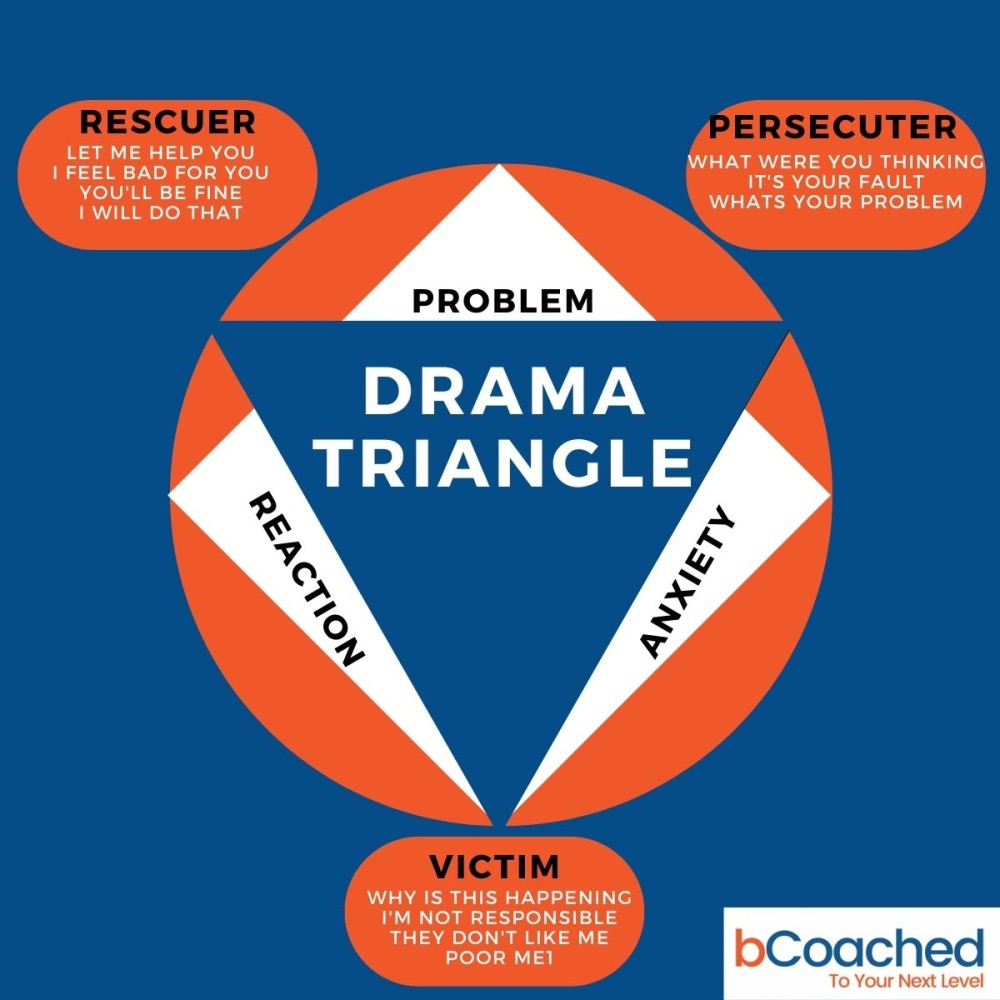
Conflict in the workplace can often come down to an interchange call The Drama Triangle.

The drama triangle is a model of social interaction which describes a power game between three personas: Persecutor, Rescuer, Victim.  Consciously or unconsciously, we can find ourselves playing one of the three roles depending on the context.

The triangle was first introduced by psychiatrist Stephen Karpman in 1968 and is also known as the Karpman Triangle.

In the workplace, the dram triangle often occurs when roles, reporting relationships and division of tasks are neither clear nor owned by stakeholders. In such circumstances, a sense of confusion steps in.

This goes hand in hand with the emotions that people feel and their unspoken needs of validation, affiliation, security and professional identity. Needs that people may not fully be aware of.

Moreover, we know that separating emotions from the real issue can be a challenge, especially when things are taken personally.

It is at this stage that we risk getting entangled in the Drama Triangle by adopting one of the personas described.

In this article I explore how the triangle shows up in conflicts and and how you can challenge it.

THE THREE PERSONAS

The Persecutor

The persecutor is the persona that is perceived as critical and self righteous; the one that keeps the other person down (the victim).   The persecutor acts like a “critical parent”, a very strick father/mother who is rigid and controlling.

Such a persona often blames the the victim without giving any solution or guidance and can, at times, turn into a bully by oppressing the victim.

The persecutor thinks “It is all your fault.”

The Rescuer

The rescuer is the persona that always feels compelled to rescue the other (the victim) even when he or she deep inside doesn’t want to.  The one that is well intentioned but with his love for help keeps the other person constantly dependent.

The rescuer can’t stop thinking “Let me help you” and by doing so neglects his/her own issues.

The Victim

Here we are talking about the persona that has the tendency to depend on someone else’s support and is often stuck in a codependent relationship. The one that feels helpless, hopeless, powerless and is inevitably seeking and attracting the attention of the Rescuer as well as the Persecutor.

The victim thinks “Poor me”.

silivia

EXAMPLE OF DRAMA TRIANGLE

John (Head of Sales): Have you submitted my expense report?

Cathrine (John’s secretary): not yet. I was up until late last night trying to complete the Sales forecast.

John: sigh…I thought we had agreed that my expense report is to be submitted well in advance and before the deadline.

Cathrine: I know…I’m sorry.  It’s the third night in row I spend on the Sales forecast.

John: well, when you get your priorities wrong, there’s nothing I can do to help you.

Maria (Sales co-ordinator): how many expense receipts do you have to submit on behalf of John?

Catherine: about 300

Maria: let me take it over from you. It shouldn’t take me long to complete and submit the report.

John: thanks Maria. If it wasn’t for you, I would find myself in caos.

THE SOLUTION

What to do if you ever get tangled in the Drama Triangle?

Transitioning to the Empowerment Triangle is the answer.

In the empowerment Triangle the three roles shift to:

PERSECUTOR to FACILITATOR: The one that respectfully approaches and treats her as a competent and professional adult without the needs of belittleling.  The ones that moves from a position of arrogance to the positon of humility.

RESCUER to COACH: the one that waits for the other person to ask for support. The one that asks questions and helps the other party to independently come to a solution. The one that empowers instead of rescuing all and give the opportunity to learn and grow.

VICTIM to CREATOR: the one that articulates and clearly explains the situation/issue. The one that owns her feeling of uncertainty and takes responsibility for doing things differently and find a way forward with the help of the coach and the facilitator.

Want to know more about conflicts in the workplace and how to manage them?  You can contact me directly for an initial consultation by using the link below:

https://calendly.com/silvia-executivecoach/30minutes

Listen or counter-argue: what is more effective in a conversation?

wmremove-transformed

Listen or counter-argue: what is more effective in a conversation?

Let’s be honest. During our daily conversations, we often listen for the purpose of counter-arguing and demonstrating that our point of view is stronger than the one of the other person.

Rarely, we listening to capture what’s behind the words of our counterpart and what’s not being said explicitly.  This art of listening, which aims to understand first, is often referred to as reflective listening or listening with intent.

When we listen with intent, we respectfully give the other person time to raise and describe their argument, without taking sides or strongly defending our point of view.  Moreover, we aim to see their standpoint without passing judgement.

When we truly listen, we genuinely hear and try to gain clarity about the other person’s perspective.  And, by doing so, we demonstrate flexibility and the willingness to step into the other person’s shoes.

After all, two people can be talking about the same thing and have independent points of view, especially when they are seeing different realities.

Listening with intent doesn’t imply that we eventually agree with the other party’s viewpoint, but it means that we give each other space to consider wider perspectives.

Approaching the other party by listening can create a pathway for resolving differences and conflicts.  Counter-arguing instead, can intensify conflicts simply because it broadens the gap between two different opinions and creates resistance.

In this article, I highlight some practical steps to enhance your reflective listening skills, so that in your daily life, including the workplace, you can create meaningful interpersonal relationships.

Reflective listening

There are two fundamental steps to consider when practicing reflective listening:

STEP 1

Listen to capture the speaker’s argument by paying attention to the words used, tone of voice, facial expression and body language.  In this context, resist the temptation to interrupt the speaker and allow him/her to finish his/her part of the conversation.  When you can, relax and sit back in your chair and allow your body to stay in a neutral position.

STEP 2

Once your counterpart pauses, reflect back to her the ideas she expressed as accurately as possible.

Here are two important techniques for reflecting back ideas (STEP 2):

Mirroring: repeat key parts of your counterpart’s message word by word, exactly as he or she said.

Paraphrasing: repeat what you heard with your own words. This is the most sophisticated version of reflective listening.

When you paraphrase or mirror, you basically try to capture what the speaker wants to transmit through his/her words without allowing your own judgement to interfere.  It is like giving your interpretation of the message received without letting your opinion or personal facts corrupting it.

When you reproduce the speaker’s message, it helps to pay attention to verbal and non-verbal cues, such as tone of voice or feet, legs and hands movements.  For instance, you can ask yourself if the tone of voice of the other person denotes optimism instead of pessimism, distance instead of warmth, anger instead of joy and much more.  This way, you try to figure out how the other person feels about the matter she is talking about.

What definitely doesn’t help when paraphrasing or mirroring is to offer advice.  This is not what reflective listening is about.

Both paraphrasing and mirroring show that you are interested in understand correctly and paying attention to what is really being said and meant by the other party.

STEP 3

Once you have paraphrased or mirrored back to the listener their own message, allow them to confirm that what you have repeated corresponds to what they intended to express.  By doing so, you are seeking confirmation that you understood them properly.

When this is not the case, the speaker will most likely counter-respond by correcting your own words and further explaining the meaning of his/her argument.

Here are two examples of paraphrasing, the most sophisticated part of reflective listening:

Example 1 – Speaker: my boss writes me countless emails per day to the point that I can’t concentrate on my tasks and complete my work.

Listener: so, I understand you are frustrated because you feel overwhelmed by the constant messaging and feel like this is affecting your performance.

Example 2 – Speaker: I went to a well renowned cardiologist in New York and he could not even give me a date for my next appointment let alone provide me with a copy of my medical report….

Listener: it sounds like you are disappointed with the way the cardiologist’s office managed your follow up visits and general communication with you…

How to practice

Reflective listening is a precious skill to have.  It does take some time though to perfect it and make it a habit.  When you want to master it, I suggest doing the following:

  • Practice with an accountability partner– it can be a colleague or a friend – and together listen to short dialogues taken from TV series.  Otherwise, read parts of a dialogue taken from your favorite book.  Paraphrase them step by step and ask your partner to give you feedback.
  • Less is more: in your daily conversation, keep it simple and short. This means, paraphrase one thought at a time with the aim to connect and establish rapport.
  • Pay attention to body language: remember, people speak with their voice and their body at the same time.  Therefore, when you listen, observe the speaker and try to capture their posture.  Is the speaker smiling and nodding when you paraphrase or is he/she hesitating by pausing?
  • Enjoy: the main point here is to create fruitful interpersonal relations, where both party can connect step by step.  See it as a process and an ongoing relationship rather than your only chance to get it right.

If you want to know more about reflecting listening or are keen to elevate your soft skills, you can contact Silvia directly: silvia@bcoached.org

Silvia Bottiniis the founder of bCoached, an international coaching practice that provides customized one-on-one as well as team coaching programs for executives and their teams. As an Executive Coach, Silvia supports leaders who aspire to sharpen the soft skills by which Performance, Influence and professional Reputation are elevated. As a Team Coach, Silvia helps teams establish their objectives, roles, tasks and responsibilities at the beginning and mid point of their formation.

For an initial consultation, you can contact silvia here: https://calendly.com/silvia-executivecoach/30minutes

Meetings bloody Meetings!

meeting_blog_bg

Meetings bloody Meetings!

Meetings, bloody meetings” is the title of a British comedy training film produced in 1976 that has become common language within the office.

Entreprise Media, the company that produced the film, described it as “the best-selling video that defines the five disciplines that transform a gathering into a professionally run business meeting. Declare independence from the drain and drudgery of rudderless meetings with Meetings Bloody Meetings!”

If you think about it, the film dates back to 1976.  By now, and forty five years after it was produced, you would think the issue of running a business meeting professionally and effectively is a task we can all master.

Quite the contrary.

To date, we are still debating what the ingredients of an effective, engaging and successful business meetings are.

And we will continue to do so.

When a group of people gathers, inappropriate actions and words can sometimes get in the way.

In this article I share with you four common behaviors of a dysfunctional meeting and the ways to tackle them.

Dominant voices in the room

We’ve all been in meetings online or in presence were one person talks too much, goes off on a tangent and even finishes other people’s sentences.

Although such a behavior may be unconsciously driven, it is disrespectful because it prevents other members from participating, sharing their voices and giving their unique contributions.

The best way to deal with a dominant voice in the room is to prevent it from happening in the first place.  Set some ground rules and make them clear to all the participants prior to or at the beginning of the meeting.

For instance, you can indicate in the agenda the time allocated to each participants for presenting their topic. This way, you create a clear structure for your meeting and indirectly give yourself permission to interrupt those that talk beyond their allocated time.

Alternatively, you can encourage people to be mindful of sharing the stage and intentionally do a little math at the beginning of the meeting by saying, for instance:

“we have 12 people in the room for a ninety-minute meeting.  If we speak 5 minutes each, that give us the opportunity to hear everyone’s suggestions before we take thirty minutes to create our solution”.

Always ensure every participants is included in the conversation.

In practice, this means inviting the participants who have not spoken to share their perspective or points the groups hasn’t considered yet.

Chronic latecomers

This is one of the behaviors that can become contagious if not addressed properly.

Not to mention the frustration it causes when the organizer feels obliged to summarize the discussion had with the other participants to bring the latecomer up to speed.

Unless the latecomer has a good reason for the delay, such behavior shows lack of respect and poor time management.

The way I personally recommend you address this issue, is to lead by example. By this, I mean that you model punctual behavior by attending meetings always on time.

Request that participants also attend meetings on time by sending them a calendar invitation along with a reminder one day prior to the meeting.

Start the meeting on time.

Don’t feel obliged to “clue in” the latecomer to what he or she has missed.  Continue the meeting as normal.

Instead, handle the situation privately and outside the meeting by asking if there are any reasons for arriving late.

Offer your support and check if you can help your colleague taking steps to arrive early.

Supporting colleagues to adjust their behavior is a component of a leadership style that aims to develop people and help them grow.

The hypercompetitive

In the workplace we’ve all come across those that uses inappropriate humor with a casual remark or a mocking phrase.  And this happens in meetings too.

When teasing conceals a mean-spirited attempt to discredit a participant, it can quickly become an offensive behavior.

It can make the atmosphere of the meeting hostile.  Even when others don’t see anything behind the casual remark and shake it off by saying:

It’s just a joke.

Just kidding! Don’t take everything so seriously.

Don’t be so sensitive!

The reasons for making an inappropriate remark can vary.

Some people thrive on conflict and they may say inappropriate remarks to engage you and their counterpart into an argument.

This could happen with hypercompetitive people, when they become offensive in an attempt to put down their counterpart.  Or when, in an effort to rise to the top, they take credit for other participants’ ideas.

When this happens, take some distance if necessary and give yourself the opportunity to see things for what they are.

Once you’ve distanced yourself from the remark and the person who made it, be intentional with your words.

State the importance of sharing perspectives respectfully and collaborating with the purpose of reaching an outcome that is supported by every participants.

Make it clear that inappropriate humor is neither welcomed nor accepted in your meetings.

Distractors

Here I refer to people that start side conversations or do other work during the meeting.

It is impossible not to notice them, especially when they create subgroups.

Such behaviors inevitably cause disengagement. And when a few people disengage during a meeting, chances are that others will follow.

There are several reasons that cause people to disengage.  However, one the biggest reasons are distractions.

People who don’t put their devices on mute and check their emails or read through an Instagram feed.

People that start a side conversation with other participants and divide the group.

Whatever the reason, my recommendation is to address it prior to the meeting so that everyone know what to expect when attending the meeting.

Here, I suggest you and your participants establish some norms.

Perhaps you can decide that devices are to be put on mute? Or placed in a basket at the beginning of the meeting?

With those who start side conversation, you can also intervene in the moment by saying: “Is there anything that the entire group needs to hear’.

Finally, bear in mind that having a separate chat about the undesired behavior and naming it explicitly can be a valuable support for the other person.

It may help them recognize the impact of their behavior on the overall meeting and build trust.

Just ensure that your understanding is not mistaken by tolerance.

Tolerance always comes with the risk that other participants take up the dysfunctional behaviors simply because they go unnoticed.

Therefore, be firm and mature when asserting the rules and norms established.

Silvia Bottini, Executive & Team Coach

Silvia is the founder of bCoached and Co-founder of Valore Aggiunto. As an executive coach, Siliva helps executives and their teams enhance their Performance, Influence and Reputation.

To know more about Silvia’s coaching programs for executives and teams, contact her directly: silvia@bcoached.org

Learn to say “No”​

1639910812992

Learn to say "No"​

Saying “No” in the workplace is an essential part of ensuring you communicate your intentions comfortably, clearly and without wasting words or unnecessary time.

After all, you would agree that a true and authentic “ no”comes from a person who understand where the boundaries are.

A person that is wise when judging her actual ability, capacity and desire to deliver.

A person that doesn’t end up promising what she can’t or won’t be able to deliver.

This said, not everyone finds the courage to say “no” when interacting with colleagues.

In this article we discuss how to say “no” from a position of a mature, responsible and assertive person.

The case

During the first two coaching sessions with my client Aneeta, a middle-aged marketing manager working for a consulting firm, I have the perception Aneeta is one of those people driven by the desire to please others.

A desire that often drives her to take on board tasks and roles against her will.

When I invite Aneeta to identify some of the scenarios and motivations that move her to be agreeable beyond the acceptable limits, her answer is:

“I mainly take on board additional requests from my boss and her colleagues.

I accept them with the intent to please people and ensure they are happy.

The truth is that I don’t like disappointing people, especially if they work with me.

Deep inside, I am afraid to confront those people who I find particularly dominant.

Those with whom I would probably end up having a disagreement if I said “no”.

To avoid unpleasant confrontations, I find myself accepting undesirable tasks or give an in-between answer, which is never to the point and as direct as “no” would be.

As I prompt Aneeta to recognise the unwanted consequences of her behavior, she admits:

“I resent my boss.

I feel used.

I’m the victim of my own choices.

I end up compromising the quality of my work.

I run the risk of missing important deadlines”.

If you were Aneeta, what would you do differently?

Here are three steps that help you stand up for yourself and set healthy boundaries in the workplace.

1) Recognize the Need and Desire of the other

When you recognize the need and desire of your counterpart you understand and acknowledge her perspective, position and motivation.

This said, you don’t have the obligation to align yourself with her position let alone accept it.

Scenario A

I am aware that producing 3000 copies of your presentation helps you finalize your work faster…

Scenario B

I understand that for you it is important to promote John to the position of Finance Director.  I understand that by doing so, you recognize his effort throughout the past four years…

2) Express your Preference and Decline the request of your counterpart

Express your position and perspective and state clearly where your boundaries are.

Scenario A

…right now I am working on our latest marketing campaign.  This task takes  priority in my agenda.

Scenario B

…I personally believe that John is not ready to face the imminent expansion of the company and needs one more year to prepare himself for the role of Finance Director. For this reason, I neither approve nor support his promotion.

3) Resist the temptation to justify your position

Stay truth to your position.

Keep your final answer.

By staying firm on your answer your counterpart will understand that she can’t persuade you any further.

Ignore any second thoughts you may come up with.

Return to the place and the activity you have defined as your “priority”.

Silvia Bottini is the founder of bCoached, an international coaching practice helping executives and their team strengthen their Performance, Presence and Professional Reputation.

Fo Leadership coaching, HOGAN Assessments & Team coaching contact: silvia@bcoached.org

Your Leadership Style: Asking systemic Questions

166457

Your Leadership Style: Asking systemic Questions

Let’s admit it: posing questions is not how we usually help others find solutions. Often as leaders we adopt the role of ‘being the expert’ and provide direction on the ‘how to’ – how to solve a problem; how to overcome unexpected challenges etc. This is undoubtedly a valuable skill and indisputably one which leaders are highly regarded for. However, is this giving of advice and providing direct answers the most effective course of action? Are we truly supporting innovative thinking and decision-making processes for our counterparts?

Scientists and innovative thinkers lead with questions to generate breakthrough ideas. Sales people lead with questions to qualify potential clients. Asking questions is indeed a powerful way of discovering facts and data in order for us to take informed decisions. However, often we are afraid of appearing foolish amongst our peers or perhaps simply uneasy on the type of questions to ask. And when exactly should we pose our questions?

In this article, I introduce a simple and yet powerful framework that highlights four types of questions, their intent and the likely outcome. This framework is based on the work of Karl Tomm, Professor of Psychiatry at the Faculty of Medicine at the University of Calgary and director of its Family Therapy Program. In the field of coaching this is called “systemic questioning”.

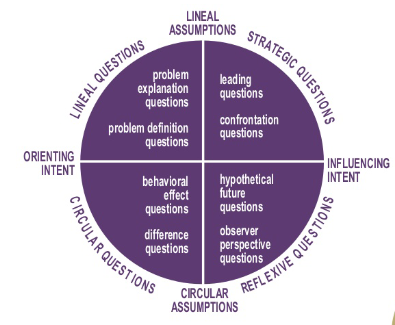
Four Types of Questions and their Function

546564564

LINEAL QUESTIONS: these represent the ABC of asking questions and their function is to find out the facts. Simply put, they are the “Who, Where, What, When” of asking questions. They are factual based and aimed at discovering more about any situation or dilemma presented. Asking lineal questions is a viable and straightforward practice for gathering information that will assist us in reaching a fairly neutral picture of the reality being discussed.

Lineal questions can be asked at the beginning of a conversation to build rapport, when we need to become aware of specific details or when we want to pull apart a complex scenario during a brainstorming session. Here are some basic examples of lineal questions:

Who contacted the client first?

What did you propose to the client?

Where did the meeting take place?

When is your deadline?

CIRCULAR QUESTIONS

Circular questions are those we draw upon when we want to find out what relationships exist between people or entities. Their function is to discover the connections and dynamics between two or more parties, including their differences, possible agreements/ disagreements etc. When it comes to circular questions, the same question may be concurrently asked to multiple people to find out what discrepancies or commonalities lay between different people. We typically ask circular questions during debates that involve people who work interdependently, such as team members, and variables that are mutually dependent. Here are some examples of circular questions:

Who intervenes more in the board meeting, the chairman or the CEO?

How is it that we have the same results when we chose two different strategies? Who else has the same results?

Has it always been done this way? Who else agrees that it has always been done this way?

How would that differ from how it is now? Would it more or less than it is now?

How does the compliance team differs from the legal team? If the two teams were in the same office, would they work more effectively?

STRATEGIC QUESTIONS

With strategic questions we enter the realm of directive questions that are aimed at influencing our counterparts. The intent is to lead and prompt the other part to make adjustments. Strategic questions often embed a suggestion and because of their instructive and somehow corrective nature they can be provocative. Their function is to encourage counterparts to consider new possibilities as well as to take ownership of the new options they have discovered. We typically ask strategic questions when our counterpart is at a crossroads, or when doubts of which course of actions to take. For instance, when the counterpart is entirely oblivious of the impact of their decisions and actions. Here are some examples of strategic questions:

What can you do now to acknowledge that your objectives have to be aligned with the organization’s objectives? (A directive and instructive question. The intent here is to prompt the counterpart to take action).

Have you always disregarded the recommendations of the marketing team?

Is the habit of keeping your team in the dark during the decisional process and old habit or a new one?

Why don’t you brief your team on what is being discussed at the management meeting? (A directive question containing a suggestion)

How come you are not willing to share with your team some of the point discussed at the management meeting? (A provocative question)

Strategic questions have to be used with consideration, especially when they are corrective and posed in a provocative way. Although they can be very effective when we notice our counterpart is in need of encouragement or even persuasion, we have to ensure we have created a safe enough and non-judgmental conversational space for them to accept our suggestions or quasi-lecture instructions. Otherwise, we risk to run into resistance.

REFLEXIVE QUESTIONS

Reflexive questions have a facilitative intent, which means they help explore deeper levels of fact, data beliefs, ideas and situations. These questions elicit answers in which the counterpart will be expected to re-evaluate their point of view. There are several reflexive questions which Karl Tomm presents in his research (Interventive Interviewing: Part III. Reflexive Questioning as a Means to Enable Self-Healing) and they would deserve a separate article. For the sake of clarity, here is the original classification and a brief explanation of their functions:

Future-oriented question

The intent of these questions is to project the counterpart into a future scenario and stimulate their imagination. The aim is to prompt our counterpart to visualize without setting those boundaries that are normally imposed by our limiting beliefs or pre-conceptions.

How will things be different between you and your boss once you will start inviting her to your clients’ meetings?

Observer-perspective question

These are questions which invite the counterpart to put themselves in the shoes of someone else to think and behave as if they were the other person.

How do you think the head of Sales team would react once she is informed of the adjustment in the commission structure?

Unexpected context-change questions

The intent of such questions is to propose a chance of scenario that your counterpart is not able to envision or hasn’t thought about.

What would it be like if you could offer your sales team a two-week negotiation training once a year?

Embedded-suggestion questions

These questions are real suggestions that help the counterpart consider another option, precisely the one we are suggesting.

Instead of thinking that your boss is uncooperative, what if you thought he is overstretched? How might you approach him instead?

Normative-comparison questions

They have the purpose of prompting the counterpart to make an accurate comparison, especially in those contexts in which they have not carefully compared two or more samples.

Do you think consumers in the Middle East are more inclined to buy online compared to consumers in Europe?

Distinction-clarifying questions

Do you think his decision to leave the firm is about x, y or may be z?

Questions introducing hypothesis

The intention of these questions is to project the counterpart into a hypothetical scenario that may or may not happen. It helps thinking ahead about the possible solutions to adopt in case the assumed situation becomes a reality. Asking such questions is an excellent exercise when, for instance, a team is asked to put in place a contingency plan.

What do you think your team can do to prepare in case of a third lock-down?

Process-interruption questions

When you see that you directions lead you to the wrong place, what do you do next?

Today I have introduced to you four key question types to practically help sharpen the reflexive ability of your teams, to help with idea generation and to help anticipate needs and analyze complex scenarios. I wonder if your perception about questioning has changed? And if it has, in which way. I have endeavored to transition thought from a position in which the asking of questions is viewed as a sign of weakness and vulnerability to one in which is an indication of skillful leadership, to guide and to get the best from your teams.

Do you want to know more about systemic questioning and desire to experience it yourself to enhance your leadership awareness and decision making process? I invite you to contact us at bCoached by using the link below.